Connecting the Dots

A Brief History of the Dot
For the past 12 months, working at Miniritchi Gallery has given me a front-row seat to some colourful questions from tourists. Anything from, ‘Is the art real?’ to, while looking at our children’s section, ‘Does Longreach actually have schools?’ Not much surprises me anymore.
But one question comes up more than any other when visitors look at my artwork: ‘Is this Aboriginal art?’
I have a fairly well-rehearsed answer about the dot. For many people outside the arts, dots in Australian painting are strongly associated with the Western Desert art movement. It is an understandable connection, but the histories, methods and cultural contexts are very different.
So where do dots come from? There is no identifiable ‘first dot’. Humans have been making repeated dots and punctate marks for tens of thousands of years across unrelated cultures. A dot is one of the simplest marks a human can make. What we can trace is the way dots became deliberate systems for pattern, tone, image-making, reproduction and, eventually, digital display.
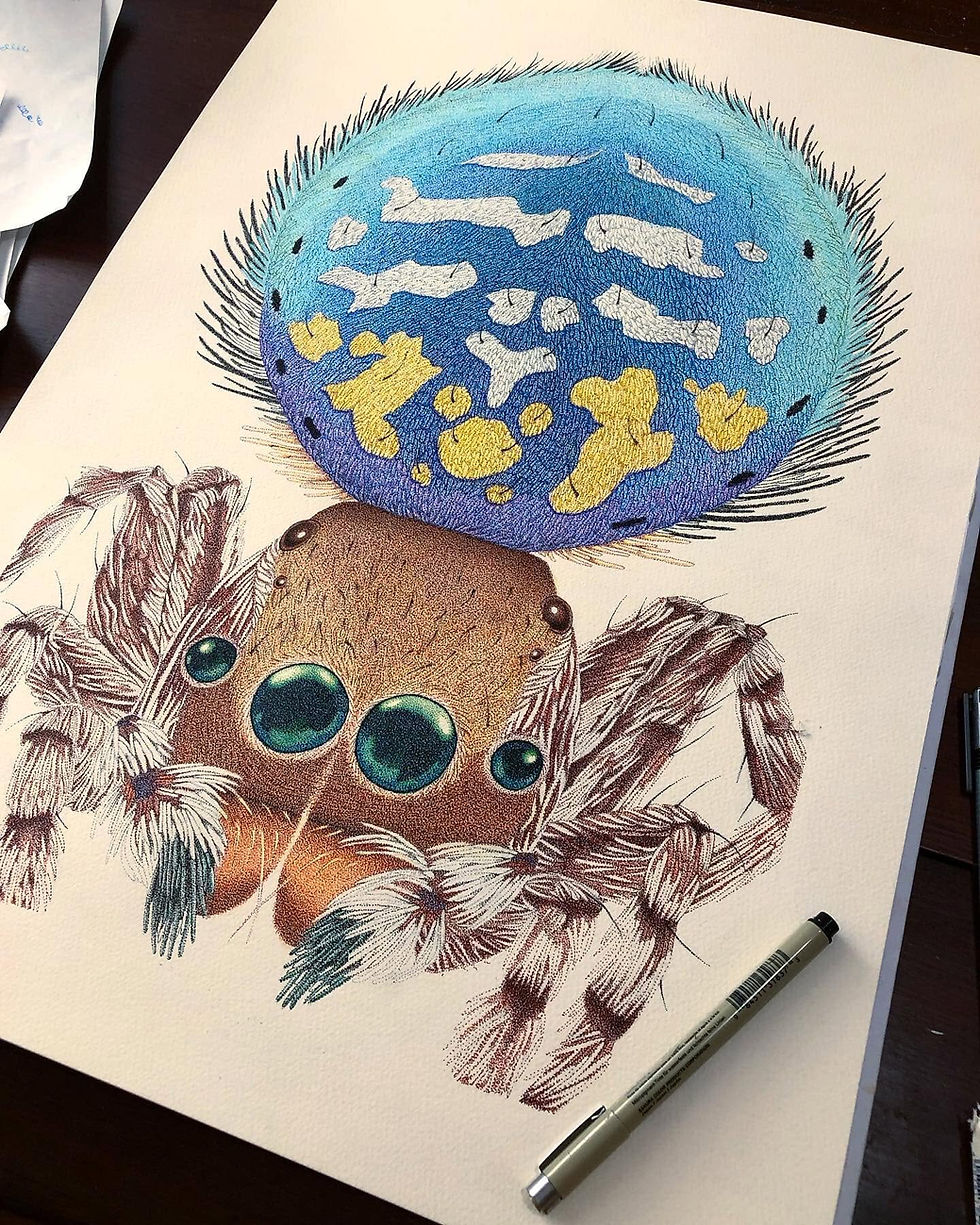
Emma Read Strataism Peacock Spider 2023

“Before anyone called it stippling, Pointillism, Ben Day, halftone or digital imaging, humans had already discovered that a collection of tiny marks could communicate something greater than any single mark.”
1. Prehistoric mark-making
Long before the dot became an artistic technique, it existed as one of humanity’s simplest visual marks. Prehistoric people painted, carved and pecked dots onto rock surfaces alongside lines, circles, handprints, animals and geometric signs. We cannot know what every group of dots meant, and they did not necessarily mean the same thing in different places or periods.
Some appear decorative. Others occur beside animal imagery. Some may have carried symbolic, practical or communicative meaning. What is remarkable is how early humans discovered the visual power of repetition. Change the spacing or arrangement and dots can become rhythm, boundary, texture, information or image.
At the French sites of Abri Blanchard and Abri Cellier, archaeologists have documented approximately 38,000-year-old limestone engravings in which sequences of punched dots were used to depict animals, including a mammoth. The technique has sometimes been nicknamed prehistoric ‘pointillism’, although it has no historical relationship to 19th-century Pointillism.
Across African rock-art traditions, dots also appear among geometric signs and alongside human and animal figures.

Rock painting from the “White Lady” panel, Brandberg/Dâureb, Namibia. Brandberg rock art dates broadly from approximately 5,000 to 1,000 years ago.
2. Ancient dots: pattern before illusion
Across ancient cultures, repeated dots appear on pottery, textiles, carved objects, jewellery and painted surfaces. In many cases the dot functions as decoration, pattern or symbol rather than as a device for modelling light and shade.
One dot is a mark. A series of dots becomes a pattern.
Repeated units in textiles offer a useful parallel. Stitches, knots and woven intersections are not literally dots, but they demonstrate the same broader principle: tiny repeated units can accumulate into a much larger image or story.

Early Neolithic ceramic vessel, 6th millennium BCE, Regional Historical Museum, Stara Zagora, Bulgaria. Punctate decoration forms repeated patterns across the vessel surface.
3. China: Mi dots and landscape
Around four centuries before Giulio Campagnola, painters in China’s Northern Song period had developed sophisticated vocabularies of repeated brush marks for rocks, vegetation, atmosphere and mountains
Mi Fu (1051–1107) became associated with a recognised landscape vocabulary now often described as ‘Mi dots’. In this tradition, layered washes and horizontal brush dots build landscape forms through depth, density and atmosphere rather than relying only on outline.
This is not European stippling. The marks are brush-made, often broad and wet, and belong to a different artistic philosophy and tradition. But conceptually, something important has happened: the dot can now help build landscape, atmosphere, mass and spatial depth.

Cloudy Mountains, Mi Youren, c. 1130. Ink landscape using the “Mi-family dots” associated with the tradition of his father, Mi Fu.

4. Medieval Europe: decorative stippling and punched marks
By the late 12th century, European artists and craftspeople were using punched and stippled marks in metalwork, enamel, manuscript decoration and painted panels.
Gold-ground paintings also developed elaborate punched decoration around halos, borders, textiles and backgrounds. These repeated marks usually functioned as ornament and surface pattern rather than the tonal stippling that would later emerge in printmaking.

Nesle-la-Reposte 1180–1200, made in Champagne, France
5. Giulio Campagnola and Renaissance stipple engraving
Around 1500–1512, Italian painter and engraver Giulio Campagnola pushed the dot into a new role. He developed delicate systems of flicks and dots with the engraving tool to create subtle tonal transitions in copperplate prints.
Instead of relying entirely on lines and cross-hatching, Campagnola used masses of tiny engraved marks to build atmosphere and tone. The dot was becoming a systematic printmaking method for continuous-looking tonal effects.
Crucially, he did not have to create every dotted image by hand. The dots were cut into the copper plate, the plate was inked, and impressions could be printed repeatedly onto paper. By the early 16th century, a field of dots could be reproduced.
One dot becomes many. Many dots become an image.

Nude Woman (Venus) Reclining in a Landscape, Domenico Campagnola, 1517. Engraving in the manner of Giulio Campagnola, showing the rich tonal effects made possible through stippled mark-making.
6. Botanical and scientific illustration
Controlled stippling and engraving became especially useful in botanical and scientific illustration. Fine dots and lines could describe minute changes in tone, texture, curvature and surface without obscuring important structural detail.
By the 18th and early 19th centuries, stipple engraving was being used in sophisticated natural-history publishing. Works such as The Temple of Flora combined stipple, aquatint and other print processes to reproduce botanical images with extraordinary tonal delicacy.

Hyacinths, 1801. Engraved by Thomas Warner after Sydenham Teak Edwards, from Robert John Thornton’s The Temple of Flora. Aquatint and stipple engraving printed in colour with hand colouring.

7. 1879: Ben Day and the commercial dot
The Ben Day process, patented in 1879 and named after American printer and illustrator Benjamin Henry Day Jr., used mechanically applied patterns of dots, lines and textures to create tone and colour economically in commercial printing.
The important shift is that the dot is no longer only an individual mark made directly by an artist. It has become part of a repeatable production system, capable of building tone, pattern and colour across mass-produced images.

Benjamin Henry Day Jr., Printing-Film patent, 1879. US Patent No. 214,493, showing an early system for mechanically applying repeated line and pattern textures
in commercial printing.

Some Typical Ben Day Screens, reproduced in Ben Dalgin’s Advertising Production, 1946. Examples of commercially produced screen patterns developed from Benjamin Henry Day Jr.’s printing process.
8. 1880s: Pointillism and Divisionism
In France during the 1880s, Georges Seurat, Paul Signac and other Neo-Impressionists took the dot in another direction. Rather than using tiny marks primarily to reproduce tone, they separated colours into small touches placed beside one another so that colour relationships could operate in the viewer’s eye.
Pointillism describes the application of small points or touches of colour, while Divisionism refers more broadly to the theory of separating colour into components rather than fully mixing it on the palette. Seurat himself preferred the term Divisionism.
Seurat’s A Sunday Afternoon on the Island of La Grande Jatte (1884–1886) became the defining example of this highly structured approach. Here the dot was not hidden. It was part of the painting’s logic.

Georges Seurat, Study for “A Sunday Afternoon on the Island of La Grande Jatte,” 1884

9. Late 19th century: halftone and mass reproduction
By the late 19th century, halftone processes transformed image reproduction. Continuous-tone photographs could be translated into patterns of tiny printable dots, allowing presses to reproduce photographs and tonal images cheaply and at scale.
Suddenly millions of people were looking at images made from dots without consciously noticing the dots at all. The individual mark had become an industrial unit of reproduction.

Halftone reproduction of James McNeill Whistler’s Arrangement in Grey and Black No. 1 (commonly known as Whistler’s Mother), 1892.
10. 1950s onward: Yayoi Kusama, repetition and infinity
Another radically different use of the dot emerged in the work of Japanese artist Yayoi Kusama (1929–2026). Her repeated marks, nets and polka dots developed into a visual language concerned with accumulation, repetition, infinity and the dissolution of boundaries between the individual and the surrounding world.
Her Infinity Net paintings of the late 1950s used obsessive repetition across the surface, while later paintings, sculpture and immersive installations expanded the dot beyond the picture plane and into entire environments.
The dot was no longer simply constructing an image. It could consume the entire space.

11. 1960s: commercial dots become Pop Art
By the 20th century, dot-based printing systems were familiar across newspapers, magazines, advertising and comic books. At normal reading distance, the dots were generally intended to merge visually into fields of colour and tone.
In the 1960s, Roy Lichtenstein reversed that expectation. He enlarged and simulated Ben Day dots so that the printing mechanism itself became conspicuous. A device designed to disappear into a reproduced image became part of the artwork.

Roy Lichtenstein, Drowning Girl, 1963. Lichtenstein enlarged and manually simulated Ben Day dots, turning the visual language of cheap commercial printing
into part of the artwork itself.
12. 1971 onward: Papunya and the Western Desert art movement
In Australia, a major new chapter began at Papunya, west of Alice Springs, in 1971. A group of Aboriginal men began painting designs using acrylic paint and boards, with materials and assistance from schoolteacher Geoffrey Bardon. This became the beginning of the contemporary Western Desert art movement and led to the formation of Papunya Tula Artists in 1972.
The movement grew from Aboriginal cultural traditions, Country, knowledge systems and ceremonial practices, not from European Pointillism, stipple engraving or commercial printing. Early Papunya painting translated forms of visual knowledge associated with sand and body painting and ceremony into new permanent materials.
Dots became one visual element among many, alongside circles, lines, tracks and other forms. Their use, meaning and significance vary between artists, communities, subjects and works. Papunya should not be treated as a single ‘Aboriginal dot-art style’, but as a place and a major historical centre in the development of contemporary Western Desert painting.
Artists associated with the early movement include Kaapa Tjampitjinpa, Johnny Warangkula Tjupurrula, Clifford Possum Tjapaltjarri, Tim Leura Tjapaltjarri, Mick Namarari Tjapaltjarri, Uta Uta Tjangala, Long Jack Phillipus Tjakamarra and Charlie Tjungurrayi.

Johnny Warangkula Tjupurrula Artworks 1971

Australian Film Commission Mr Patterns 2004

Uta Uta (Wuta Wuta) Tjangala Pintupi language group, about 1926–90
13. Late 20th century onward: the dot goes digital
Before computers, halftones were produced using optical and photographic processes that broke continuous-tone images into printable dot patterns. Digital imaging retained the underlying idea but moved much of the calculation into software.
Digital halftoning recreates tonal gradients using discrete marks or cells. Dithering arranges limited colour or brightness values so the eye perceives intermediate shades and smoother transitions.
Computer displays take the principle in another direction again. Images are built from pixels, tiny addressable picture elements. On colour displays, pixels commonly use red, green and blue subpixels whose combined light produces the colours we see.
Printed dots, calculated dots, illuminated pixels. Once again, many tiny units become an image.

14. Strataism: the return to the hand-made mark and accumulated layers
My own work sits within this long history of mark-making. In 2015, I came across the highly detailed black-ink drawings of Australian artist CJ Hendry. Her work reminded me of stippling exercises from high school art classes, and I began experimenting with fine ink mark-making again.
Over the years, that experimentation gradually developed into a technique of my own. I still use the basic mechanism of stippling, working with fine 0.01 mm and 0.4 mm fibre-tip ink pens, but the process has expanded well beyond black dots alone. I use the term Strataism to describe a layered method of image construction built through watercolour, ink washes and thousands of individually placed ink dots.
This process draws from Western traditions such as stippling and pointillism, but it is not confined to either. Traditional stippling often builds tone through the density of black dots. Pointillism separates colour so that it blends optically in the viewer’s eye. My work borrows aspects of both, but Strataism is broader than either one. It is not purely about tone, and it is not purely about optical colour mixing. It is about layered accumulation.
Up close, the image breaks apart into thousands of individual decisions. From a distance, those marks resolve into feathers, fur, skin, stone, foliage and atmosphere. The dot is not the artwork by itself. It is one component within a larger visual structure.
In that sense, Strataism is both old and new. It participates in one of the oldest impulses in image-making, the repetition of small marks to build something larger than any single mark, while also being my own contemporary method of constructing an image through layers.

Emma Read | Strataism Crows Ash Seed Pod 2022

0.01 mm Fibre tip ink pen and water colour
15. Conclusion: connecting the dots
The dot may be one of the simplest marks a human can make, but history shows it has never meant only one thing.
Across time and culture, dots have served many purposes. They have been marks on rock, decorative patterns on ancient objects, atmospheric brush marks in Chinese landscape painting, ornamental punches in medieval objects, tonal devices in engraving, tools of scientific observation, mechanical units in commercial printing, optical colour in Pointillism, immersive repetition in contemporary art, visual elements within Western Desert painting, and digital building blocks in pixels and screens.
What links these histories is not a single continuous tradition, but a shared discovery: small repeated marks can build something greater than themselves.
What separates these histories is context.
A dot can describe light, carry meaning, structure a composition, reproduce an image, transmit or protect cultural knowledge, or generate a digital picture. Its identity depends on who is making it, why it is being used and what tradition it belongs to.
That is why visually similar works cannot automatically be understood as the same thing.
My own work is sometimes mistaken for Aboriginal art because dot painting has become one of the most widely recognised visual associations with Aboriginal art in Australia. But the dot alone is not enough to define a practice. The meaning of a mark is shaped by its method, purpose, history and cultural context.
To connect the dots is not simply to notice a visual resemblance. It is to understand the different histories those dots carry.
And perhaps that is the real lesson of the dot. A tiny repeated mark, whether painted, printed, carved or illuminated on a screen, can hold an extraordinary amount of human thought, culture and invention.

Emma Read Yayoi Kusama Exhibition Qantas Museum Longreach 2024
(Photo Aaron Skinn, Satisfaction Photography)


Comments