I Reached $200,000+ Milestone with a Creative Side Hustle


This year I reached a milestone I did not know I had reached. More than A$206,000 in documented gross event sales and invoiced activity across nine calendar years, from what was essentially a part-time creative side hustle.
I did not believe the number when I first saw it. I had to go back through old Wix records, invoices, event files and years of paperwork before I could see the business as a whole. There were jobs I had forgotten, towns I had forgotten travelling to and early events I barely remembered running.
Nine years of creative experiences that I could never have imagined when I started. Yet there it was, sitting quietly in the records. And the strange thing is that this was never a carefully mapped-out business.
There was no grand launch.
There was no polished business plan.
There was not even a business name.
The idea that started it
Around 2018, I came across a Forbes article about the experiential business model behind Paint Nite making $50 million. What caught my attention was not painting itself. I was already a practising artist and professional photographer, and I had spent years working in events and marketing.
What interested me was the business structure.
Instead of carrying the cost of a permanent studio, creative experiences could be taken into existing restaurants, pubs and venues. The venue already had the room, furniture, hospitality and customers. The creative operator brought a new experience through the door.
I remember thinking: I could do this.
I had previously worked within a franchise model, so I understood why franchises are attractive. They offer a framework, branding and the feeling that somebody has already worked everything out for you. But I also knew I did not want to hand over a large part of my revenue for work I was capable of doing myself.
What I did like was the framework.
That idea of creating a repeatable structure and then using it again and again would eventually become one of the foundations of how I operated. A Toyota Echo and an ambitious email. At the time I was living in Warwick with five horses. I bought some inexpensive equipment and canvases, packed everything I could into my little Toyota Echo and started pitching. Looking back now, I was remarkably optimistic. I had no evidence the idea would work. No photographs of successful events. No customer reviews. No established creative-event brand. So naturally, I aimed high. I emailed the events coordinator at The Star on the Gold Coast and pitched an adult Paint & Sip. They replied almost immediately.
But instead of asking about Paint & Sip, they asked: “Can you do kids activities?”

Starting out with my Toyota Echo
Kids activities were definitely not part of my master plan. My experience extended roughly as far as doing things with my little nieces. But I had always liked Richard Branson's philosophy of saying yes and figuring it out along the way. So, I said yes. And it was a screaming success.
For a first job, it was extraordinary. Suddenly the idea was no longer theoretical. People wanted the experience. From there came restaurants, venues, private parties and more events. It worked. And then, less than a year after I had started, everything stopped.
Q Fever changed everything.
In 2019 I was hit very hard by Q Fever. I was hospitalised and became almost completely incapacitated. I could not work. At times I could barely care for myself, let alone five horses.
The little business I had only just begun building came to a complete halt. Eventually I travelled home to Winton in remote Western Queensland so my dad could care for me.
At the time, I genuinely felt as though I had lost everything. Recovery was not quick.
I was trying to rebuild my health while dealing with the reality that I simply did not have the physical capacity I had before. That matters when I look back at the business now. When people see a number like A$200,000, it is easy to imagine nine years of relentless growth, weekly events and somebody operating at full capacity. That was not my reality.
I was not operating at full capacity. There were periods where I could have run events every week if my health had allowed it. It did not. So the business had to fit around what I could physically manage. And unexpectedly, that became one of its greatest strengths. Starting again in regional Queensland. When I slowly began working again, I was no longer building the business around the Gold Coast.
I was rebuilding it in regional and remote Queensland.
That meant different towns, different venues, very long distances and a very different market. But the model was flexible enough to come with me.
I could take a booking when I was able to work.
I could travel when my health allowed it.
I could slow down when I needed to.
I could run one strong event rather than maintain the overheads and constant operating demands of a permanent studio.
It kept ticking along at my pace. During a period of serious illness, that mattered enormously. This little creative side hustle gave me something I could continue building without asking my body to behave as though nothing had happened.
Then another unexpected opportunity arrived. During the COVID period, Queensland Health approached me as new funding became available. The creative experience began evolving again. What had started as a social Paint & Sip model could also be used differently, including as a vehicle for connection and mental wellbeing. Once again, the format changed.
The underlying idea did not.
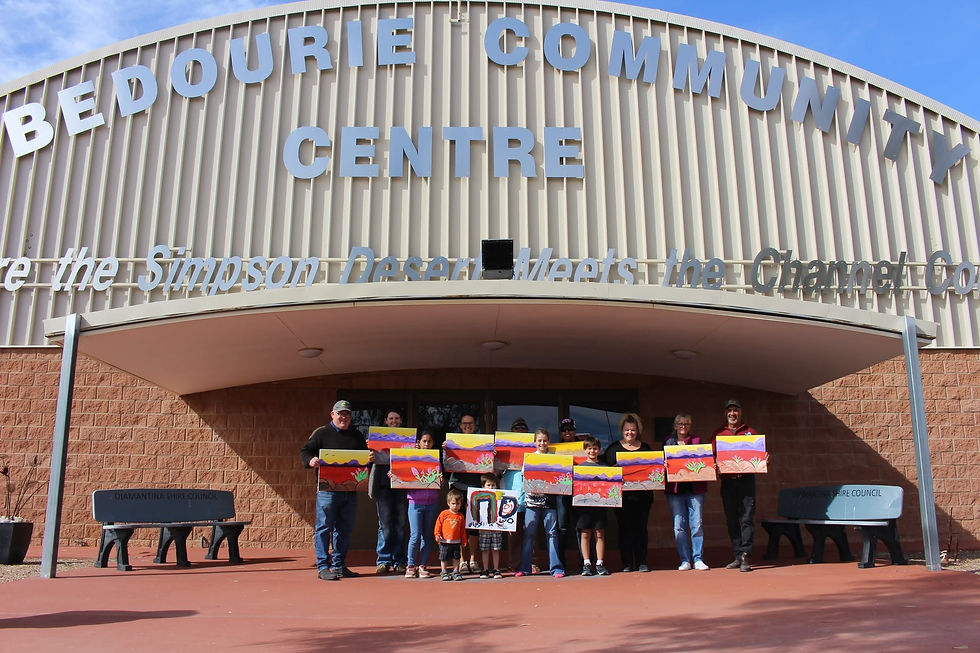
Connecting on Canvas | Government Funded Mental Health Events Bedourie QLD 2021
Celebrating A$200,000+
I am incredibly proud of what this little business became. Not only because of the numbers, but because of the communities it allowed me to work with, the relationships I built with venues, businesses, councils, health organisations and other creative people, and the opportunities it created during periods of my life when I needed flexibility more than anything.
Looking back through the records, I can now document more than A$206,000 in gross event sales and invoiced activity across nine calendar years, including more than 2,700 tickets recorded through Wix alone.
That figure is not profit, and it was never the result of running this business at full capacity.
For much of those nine years, it was a side hustle. At different points it had to fit around illness, recovery, other work, long-distance travel and the realities of living and working in regional Queensland.
That is part of why I am proud of it. It worked anyway. It kept adapting. And it kept teaching me.

What the business taught me.
The mobile business taught me how to build partnerships, market an experience, manage logistics, price work properly, read a room and make creative participation feel accessible to people who might never describe themselves as creative.
Those lessons travelled with me into later arts and cultural work, including running Miniritchi Gallery in Longreach. But the creative workshop system itself remained valuable because it had been tested repeatedly in the real world, across different towns, audiences, venues and delivery models.
It was not theory. It was something I had built by doing the work. Turning nine years of lessons into a system. Eventually I realised I had accumulated something much more useful than a collection of Paint & Sip stories. I had built an operating system.

That became the Creative Experience Launch System.
I wanted to turn the lessons I learned the slow way into a practical path someone else could follow from idea to paid event without needing nine years to work out every little thing.
A framework I wish I had when I started: how to test the idea, price it, find the right venue, fill the seats, run the room, decide what is worth repeating, and use the tools available now to make the work easier.
All someone needs a creative activity people can enjoy, a way to teach it simply, a venue or delivery space, numbers that make sense, a clear way to market it and a system you can repeat. I started with some inexpensive art supplies, an ambitious email and a Toyota Echo. I had no idea where it would lead.
Today, I can look back at more than A$206,000 in documented activity, thousands of tickets, countless kilometres, extraordinary communities and a business that helped carry me through some very difficult years.
And now I get to turn everything it taught me into something that might help someone else start.

That feels like a milestone worth celebrating.
Ready to build your own creative experience?
Emma Read
Social Collective Events
The Ultimate Creative Experience


Comments